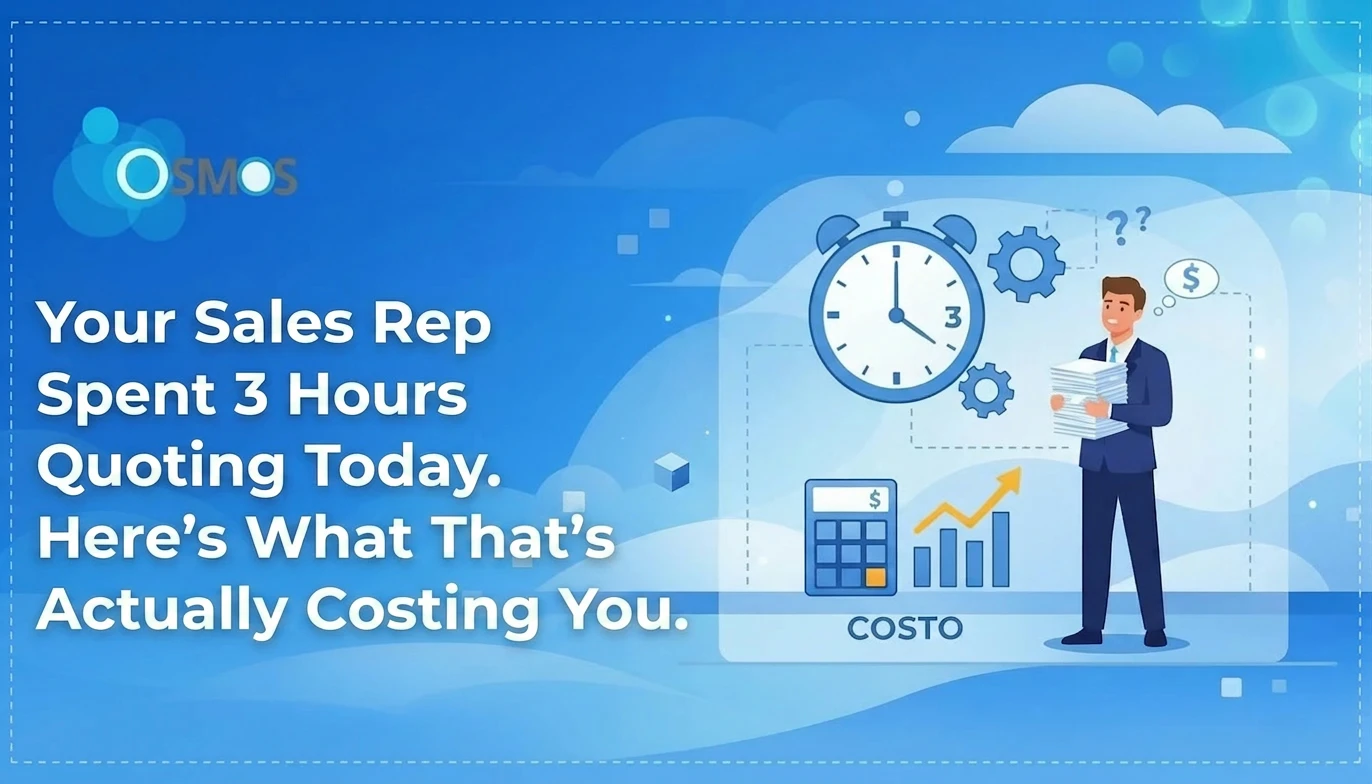
Six quotes a day at 25 minutes each. That's 2.5 hours of your rep's day gone before they've made a single follow-up call. Not 2.5 hours of selling. Not 2.5 hours of relationship-building. Two and a half hours of copying line items into a spreadsheet, formatting prices, attaching a logo, and hoping the PDF doesn't look terrible on mobile.
Most business owners look at that and think: "That's just part of the job." It's not. It's a cost. And when you actually run the numbers, it's one of the biggest hidden costs in a small sales operation.
Let's Do the Math
A rep sending 6 quotes a day at 25 minutes each burns 2.5 hours daily on quote-building alone. Over a five-day week, that's 12.5 hours. Nearly a third of a 40-hour work week spent on admin, not sales.
At a fully-loaded rep cost of $25 to $35 per hour (salary plus benefits, which is a reasonable range for a small business), those 12.5 hours cost you $312 to $437 per rep per week in labor. That's just the quote-building. No follow-up, no prospecting, no closing. Just building the quote.
Annualize that: $16,000 to $22,700 per rep per year. Spent on formatting spreadsheets.
Now scale it. If you have a team of five reps each sending six quotes a day, you're collectively losing 12.5 hours of selling time every single day. That's more than one and a half full-time employees doing nothing but building quotes. You're paying for a headcount you didn't hire and can't see on any org chart.
The Opportunity Cost Nobody Talks About

The salary math is bad enough. The opportunity cost is worse.
Every hour a rep spends in Excel is an hour they're not calling the warm lead who opened their last quote. Not following up on the proposal that's been sitting unanswered for four days. Not closing the deal that's already in the pipeline.
Here's the thing about buyers who request quotes: they're usually shopping multiple vendors at the same time. The first polished quote in their inbox has a real structural advantage. Not because it's more detailed or more persuasive, but because it arrived first, while the buyer was still in a buying mindset.
When your rep spends 25 minutes building a quote, that's 25 minutes during which the buyer might have already received something from a competitor. Speed matters here in a way that's easy to underestimate.
Then there's follow-up. Most small sales teams have no formal system for what happens after a quote goes out. The rep sends it, moves on to the next one, and the quote just... sits there. No nudge, no check-in, no second touch. A meaningful chunk of quotes never get followed up on at all. Not because the rep doesn't care, but because they're too busy building the next six.
Hiring More Reps Won't Fix This
This is worth saying directly: if your reps are spending a third of their day on admin, adding headcount doesn't solve the problem. It scales it.
You'd be hiring someone to spend a third of their time building spreadsheets too. The labor cost per quote doesn't change. You just have more people doing it.
The fix isn't more bodies. It's removing the bottleneck that's eating the time in the first place. That's a different kind of problem, and it has a different kind of solution.
If you're curious why reps find this part of the job so draining, the reasons go deeper than just the time it takes. But the short version is: building quotes manually is repetitive, error-prone, and completely disconnected from the part of sales that actually feels rewarding.
What the Bottleneck Actually Looks Like

The manual quoting problem usually has a few layers.
First, the request itself is messy. A customer emails something like "can you send me a price for the usual stuff plus a few extras" and the rep has to go back and forth to figure out what they actually want before the quote can even be started.
Then comes the building process: opening the spreadsheet, finding the right products, pulling current prices, formatting the layout, adding images if they bother, double-checking the math, exporting to PDF, attaching it to an email, and writing a subject line that doesn't sound robotic.
Then the follow-up: remembering to check back in two days, then again a week later, then deciding whether to try one more time or let it go.
Every one of those steps is manual. Every one of them takes time. And every one of them is a place where something gets dropped.
The comparison between quoting software and spreadsheets isn't really about features. It's about how many of those steps you can stop doing by hand.
What Changes When Quoting Takes Under 60 Seconds
This is where Osmos comes in, and the shift is pretty concrete.
Instead of a vague email request, the rep gets a structured quote request. Osmos's e-quote widget sits on your website (or Facebook page) and lets the customer select the products or services they want priced. The rep gets a clean, organized request with no back-and-forth to figure out what they actually need.
From there, the rep reviews the request, adjusts pricing if needed, and sends a polished, image-rich quote. The whole thing takes under 60 seconds. Not because corners are being cut, but because the structure is already there.
That 2.5 hours of daily admin doesn't disappear entirely, but it shrinks dramatically. And the time that's freed up goes back to actual selling: following up on open quotes, calling warm leads, closing deals that are already close.
The follow-up piece matters as much as the quoting speed. Osmos's Pro plan includes automated follow-up sequences, so after a quote goes out, the system handles the touchpoints based on rules you set. The rep doesn't have to remember. The quote doesn't just sit there.
For businesses sending 100 or more quotes per month, even cutting 10 minutes per quote saves 16-plus hours a month. That's real time, not a rounding error. And it compounds across a team.
If you want to see how a smarter quoting process affects the full sales cycle, the mechanics are worth understanding before you decide whether this kind of change makes sense for your operation.
The Reframe That Actually Matters
The goal here isn't to get your reps to work harder. They're probably already working hard. The goal is to stop asking them to spend a third of their day on something a well-designed tool can handle in seconds.
When quoting is slow and manual, it creates a cascade: quotes arrive late, follow-up is inconsistent, deals go cold, and the rep is too buried in admin to notice until it's too late. When quoting is fast and structured, the cascade runs the other way.
Osmos isn't a massive CRM overhaul. It's not a 200-feature platform that takes six months to configure. It sits between Excel and enterprise software, purpose-built for exactly this problem: quoting and sales automation for teams that send a high volume of quotes and need to do it faster without hiring more people to do it manually.
The math on manual quoting is pretty clear once you actually run it. The question is whether you want to keep paying for it.