Trusted by 200+ businesses across the Americas




Comparison guide
Practical guide to choose: integrated ERP or specialized quoting
Direct Answer: Odoo and Osmos can both create quotes, but they're designed for different needs. In Odoo, quotes are part of an ERP flow: Quotation → Sales Order → Delivery → Invoice, with options for templates, optional products, online signature, and payment confirmation.
Osmos is designed for B2B teams that live by quoting fast and following up: you send quotes in PDF or web version, can track when they were opened/viewed, and automate follow-up so no prospect goes cold.
Rule of thumb: Choose Odoo if your priority is an integrated system (sales + inventory + accounting + operations) and you're willing to invest in an implementation project. Choose Osmos if your priority is quoting speed + prospect follow-up + commercial process control, with quick deployment.
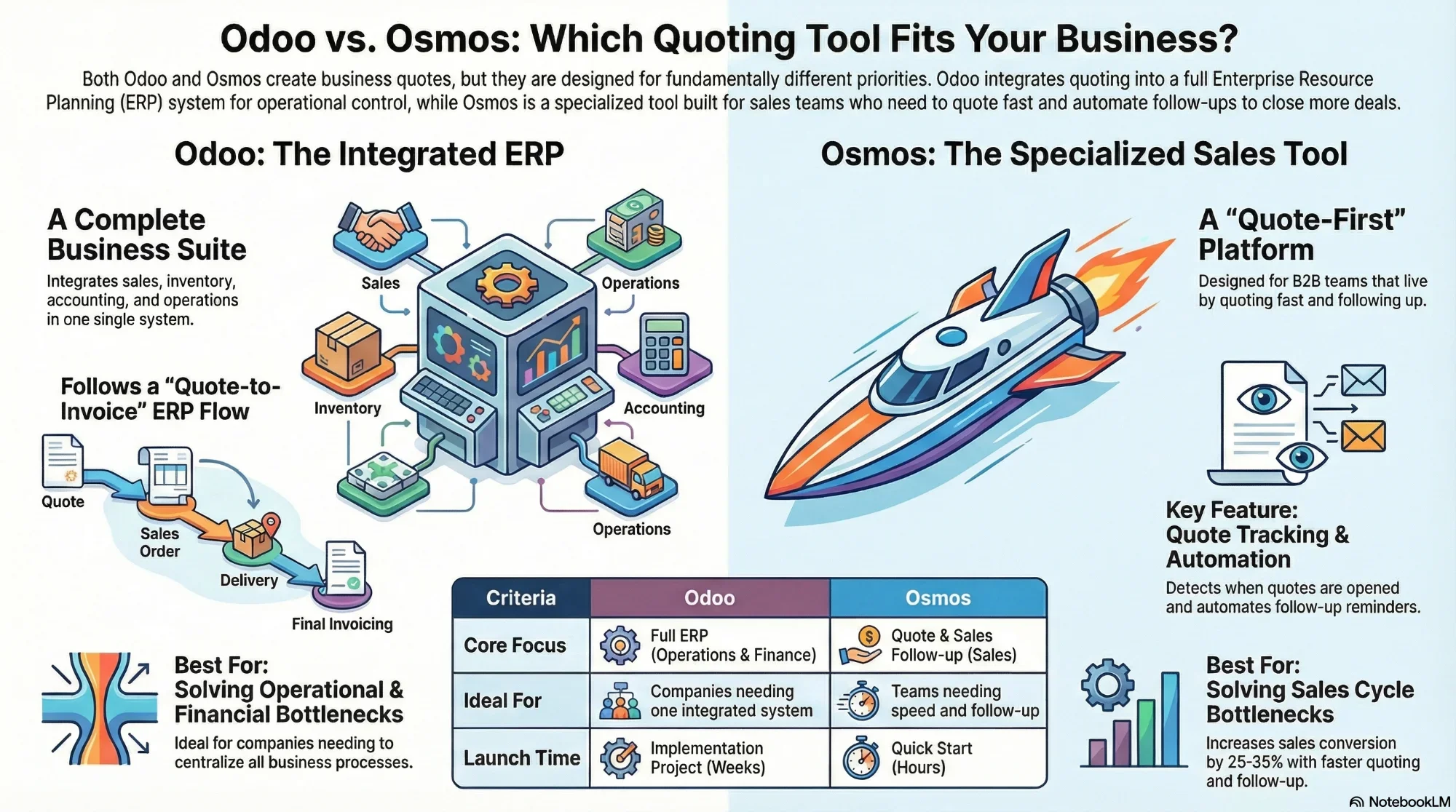
Visual guide to choosing between full ERP or specialized system
System definitions
In Odoo, "quoting" refers to the quotation functionality within the Sales module: a quote that, when accepted, becomes a sales order and connects with delivery and invoicing.
Documented features:
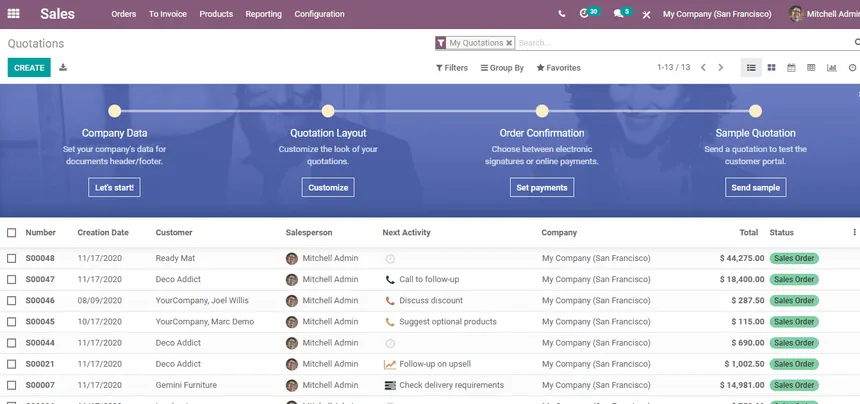
Screenshot: Odoo ERP flow - Quote → Order → Invoice
Osmos positions itself as a system focused on quoting and follow-up automation: send quotes in PDF or web, detect opens/views, and automate follow-up.
Main focus:
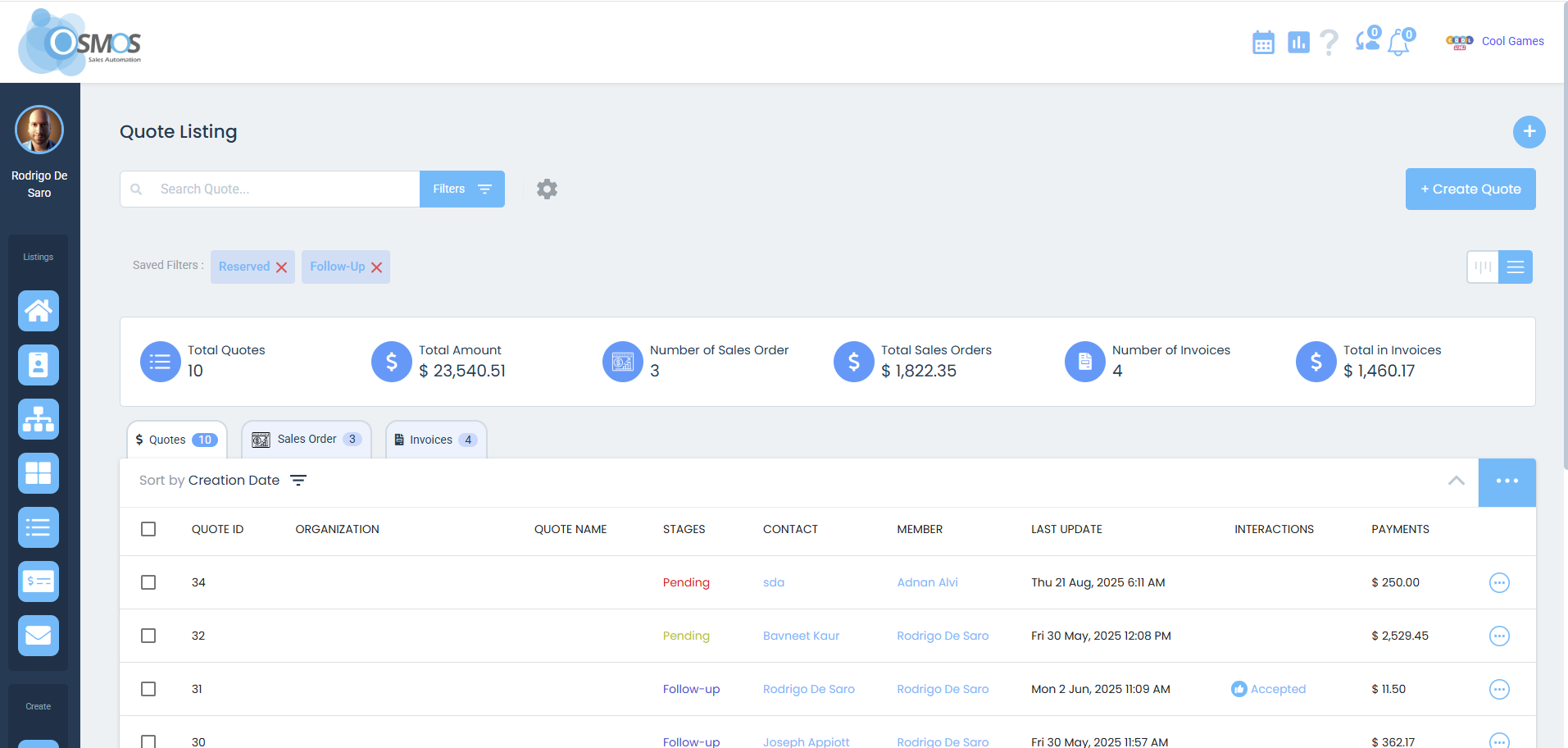
Screenshot: Osmos dashboard - Follow-up and automated alerts
Where teams struggle
An integrated ERP like Odoo may make more sense: centralizes sales, inventory, purchasing, accounting, and operations in one system.
A "quote-first" tool like Osmos usually performs better: fast quoting + structured follow-up = more closed sales.
Technical differences
Osmos is native quoting and CRM software. Odoo started life as an ERP — originally OpenERP — and quoting is just one of its many modules. That difference in origin shows in how focused each sales flow is.
Osmos is built on Node and Angular: fast, current, and easy to use. Odoo tends to feel more dated, with more friction for the day-to-day sales team.
In Osmos you add fields and adjust your process on your own. In Odoo, customizing usually takes deep technical expertise or hiring an Odoo partner.
Comparing Osmos to other tools? See them all on our comparisons page.
Process comparison
A typical flow documented by Odoo:
Includes templates, online signature, and payment confirmation (depending on configuration).
Designed to reduce sales friction:
Focus is on speed and structured prospect follow-up.
Side-by-side
Analyze key differences to make your decision:
| Criteria | Odoo (Quoting) | Osmos |
|---|---|---|
| Focus | ERP: quote connected to order/delivery/invoice | Quote + sales follow-up (quote-first) |
| Templates / optional products | Templates and "optional products" documented | Templates + catalog and fast quoting |
| Signature/confirmation | Online signature to confirm orders (documented) | Digital acceptance/eQuote |
| Open tracking | Not the main focus in documentation | Open/view detection + automation |
| Invoicing | Options to invoice from order | Order/invoice conversion optional |
| Integrated modules | Yes - Inventory, purchasing, accounting, operations | Sales focus (integration with other systems) |
| Base pricing | One App Free; Standard/Custom plans per user/month (see pricing) | 30 days free no card; plans from $29/user/month |
| Launch time | Usually implementation project (depending on scope) | Quick start (hours, not weeks) |
| Ideal for | Companies needing full ERP with integrated sales | Teams that live by quoting and following up |
Osmos accelerates the sales cycle without complex projects.
See Osmos Demo30-day trial • No credit card • Launch in hours • Support included
Decision guide
Use cases
Need: Catalog + fast quoting + automatic follow-up
Recommended system: Osmos
Why: The "quote-first" focus allows responding in 3-5 minutes vs 30-40 minutes. Automatic follow-up increases conversion 25-35%. See distributor solution.
Need: Centralize sales → production → delivery → invoicing → accounting
Recommended system: Odoo
Why: The integrated ERP flow connects all processes. Quotes convert to orders that trigger production, deliveries, and invoicing automatically.
Situation: Odoo covers ERP, but prospect follow-up isn't well solved
Options: 1) Implement follow-up process in Odoo, 2) Use Osmos for sales + Odoo for operations
Consideration: The key is ensuring follow-up is easy, repeatable, and actually used by the sales team.
Questions
Yes. Odoo documents creating/sending quotes, templates, optional products, and online signature for confirmation.
Yes. Odoo describes the flow quotation → sales order and the creation of invoices based on the sales order.
Osmos focuses on quoting speed and follow-up: sending via PDF/web, detecting opens/views, and automatic reminders so no prospect goes cold.
Usually better to prioritize the system that makes follow-up easy and repeatable for the team. Osmos is specifically built around this: opens/views detection + follow-up automation.
Odoo usually fits better due to its ERP suite approach with "all apps" in Standard/Custom plans and integrated operational flow to invoice.
Odoo shows a "One App Free" plan ($0) and Standard/Custom plans per user/month on their pricing page.
Yes. The Osmos pricing page indicates 30 days free trial with no credit card required.
Yes. Many companies use one system for quoting and follow-up, and another for accounting/operations. The key is defining a clear flow to avoid duplicate data.
Takeaways
The choice between Odoo and Osmos depends on your main priority:
For B2B teams focused on closing more sales with structured follow-up, Osmos offers:
Try Osmos free for 30 days and see if it accelerates your sales cycle. See plans and pricing.
If your bottleneck is sales, not operations, see the difference.
30 days free • Launch in hours • Support included