Trusted by 200+ businesses across the Americas




Quote-to-Cash
Complete guide to the sales cycle: from quote creation to cash collection
At a glance
Direct Answer: Quote-to-Cash (Q2C) is the complete process from creating and sending a quote to collecting payment and closing the sale. It's not just "making a quote": it includes prospect management, approval, order processing, invoicing, payment collection, and follow-up to ensure nothing falls through the cracks.
A well-defined Q2C reduces errors, accelerates closes, and improves cash flow by standardizing what each person does and what happens after each step. A typical flow is: Prospect → Opportunity → Quote → Approval → Sales Order → Invoice → Payment → Reconciliation.
When Q2C is fragmented (Excel + WhatsApp + email + accounting), delays appear: quotes without follow-up, duplicate versions, improperly approved discounts, and late invoices. At Osmos, the goal is a simple, controllable Q2C: standardized quotes, automatic follow-up, and state visibility to move from "quoted" to "paid" without friction.
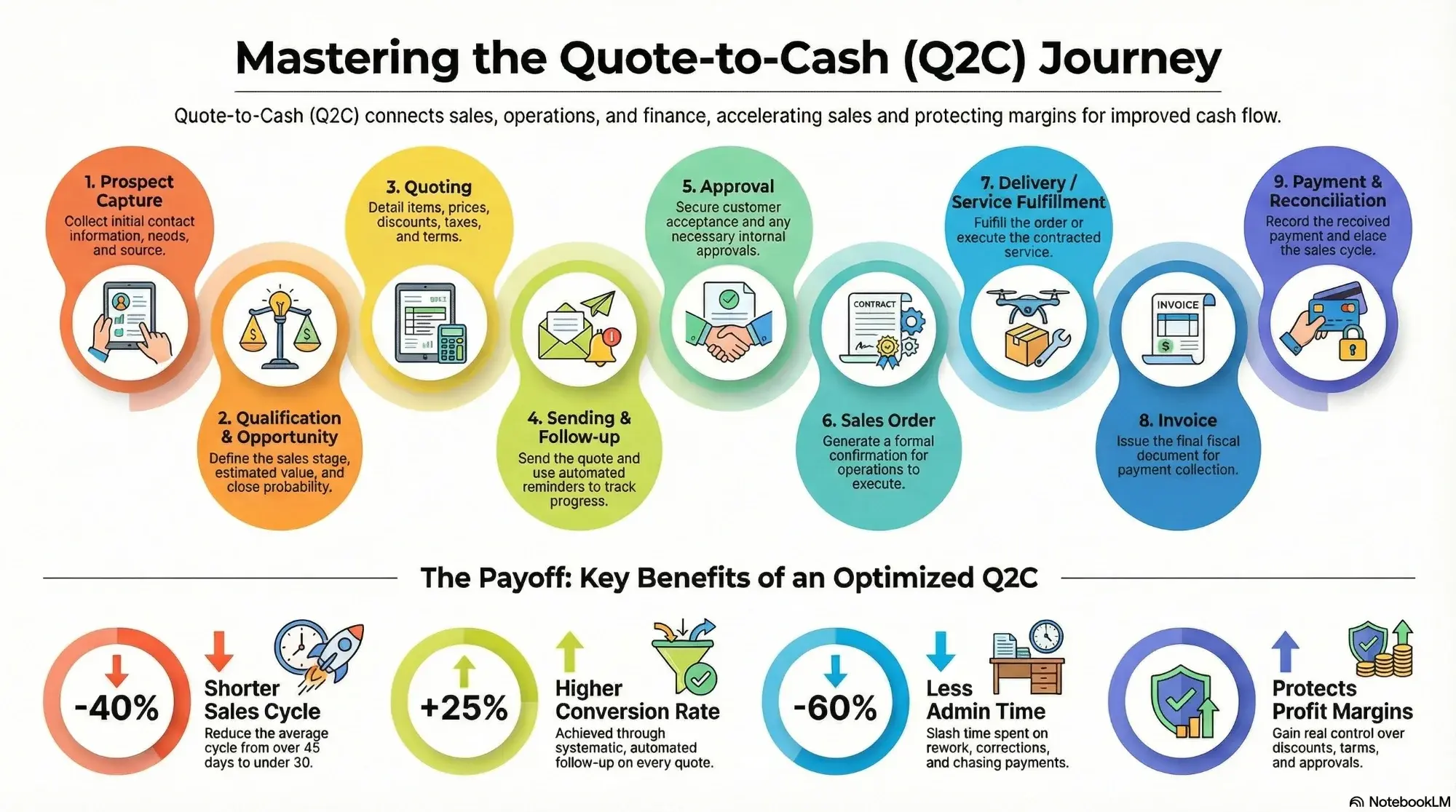
Visual flow of the Quote-to-Cash process: from quote to payment
Definition
Quote-to-Cash literally means "from quote to payment." It's a system and discipline for managing the entire commercial cycle:
It's the complete chain with clearly defined states and owners.
Business impact
A solid Quote-to-Cash process directly impacts:
Less friction to approve and buy. From weeks to days (or days to hours).
Real control of discounts, terms, and approvals to protect margins.
Collect faster with less back-and-forth between sales and finance.
Everything clear, consistent, and professional: from quote to receipt.
The process works whether your team grows from 3 to 30 people.
Know exactly where each opportunity is and how long it's been in each stage.
The full cycle
The complete Quote-to-Cash cycle includes these key phases:
Source, need, basic data, and initial contact
Define stage, estimated value, and close probability
Items, prices, discounts, taxes, terms, and validity period
Automatic reminders, tasks, and state control (sent, viewed, negotiating)
Customer accepts + internal approvals if special discounts or off-rule conditions
Formal confirmation for operations/logistics to execute
Physical fulfillment or execution of contracted service
Final fiscal document for payment collection
Record received payment, reconcile with bank, and close the cycle
Recommended states for real control: Draft → Sent → Viewed → Negotiating → Approved → Won/Lost → Invoiced → Paid
Discover how Osmos unifies quotes, follow-up, and conversion in one system.
See Osmos in Action30-day trial · Simplified Q2C · Setup in 1 hour · Support included
Benefits
A well-implemented Quote-to-Cash process generates:
Common pitfalls
These are the points where the process typically falls apart:
Consequence: Poorly made quotes, rework, and customer frustration
Consequence: Customer approves old document, conflicts over prices and terms
Consequence: Prospect goes cold waiting for response; goes with competitor
Consequence: Errors and delays in invoicing; customer already paid but invoice arrives late
Consequence: Data duplication between CRM, quoting, ERP, and accounting
At each stage
| Q2C Stage | What's decided | Common error | How to fix it |
|---|---|---|---|
| Prospect/Opportunity | Need and priority | Missing basic data | Required fields + checklist |
| Quoting | Price, scope, validity | Duplicate versions | Version control + states |
| Approval | Acceptance and discounts | Slow approvals | Automatic rules + notifications |
| Order/Delivery | What's delivered and when | Unrecorded changes | History + notes + tasks |
| Invoice | Final payment | Late invoicing | Automate conversion |
| Payment | Real cycle closure | No follow-up | Reminders + payment tracking |
Use cases
Characteristics: Many daily quotes, volume discounts, fast margin approval
Q2C Need: Templates with catalog + automatic discount rules + fast conversion to order
Impact: Q2C cycle from 30 days reduced to 15 days; +40% volume processed with same team
Characteristics: Production times, logistics, and variable costs that must be reflected in quote
Q2C Need: Quote with delivery times + approval tracking + production states
Impact: -50% last-minute changes; +25% predictability in closes
Characteristics: Quote by scope + invoice by milestones or project progress
Q2C Need: Version control for scope changes + partial invoicing + collection tracking
Impact: 30% better cash flow by invoicing milestones; fewer scope disputes
Characteristics: Ultra-fast response + automatic follow-up to not lose hot prospect
Q2C Need: Quote in minutes + automatic reminders + direct conversion to order
Impact: Conversion rate from 12% to 21% with systematic follow-up
Why Osmos
Osmos is designed for teams where Quote-to-Cash is critical:
Customer stories
I really like the way Osmos creates quotes for me. It helps me keep a standard and neat presentation toward my clients.
What I like about Osmos is that it combines the CRM with the quotes in a seamless manner.
Questions
No. CRM manages prospects and opportunities. Q2C also includes quoting, approval, order, invoice, and payment. CRM is one part of Q2C.
Q2C starts at the quote stage. O2C typically starts at the order. Q2C is more complete for consultative and B2B sales where quoting is critical.
Post-quote follow-up and version/approval control are the points where most sales are lost. Without a system, people forget to follow up or approve old versions.
Standardize templates and catalog, define clear approval rules, use states for visibility, and automate follow-up and conversions between stages.
Yes, especially. WhatsApp speeds up conversations, but without a Q2C process you lose follow-up, control, and state visibility. The combination is powerful.
Osmos unifies quotes, pipeline, and follow-up to move from quoted to paid with less friction. Everything in one system, no data duplication between tools.
Takeaways
Quote-to-Cash isn't just "making quotes": it's the complete process connecting sales, operations, and finance to convert opportunities into collected cash in a predictable and scalable way.
When Q2C works well:
Companies that optimize their Q2C typically see:
The best Q2C system is the one your team actually uses because it connects every step of the process, eliminates friction, and provides end-to-end visibility. With Osmos, over 200 companies in Latin America have already simplified their Quote-to-Cash to grow without complications.
Get started
Personalized demo of how to unify your complete process: from quote to payment.
30 days free · No installation · Support included · Start today