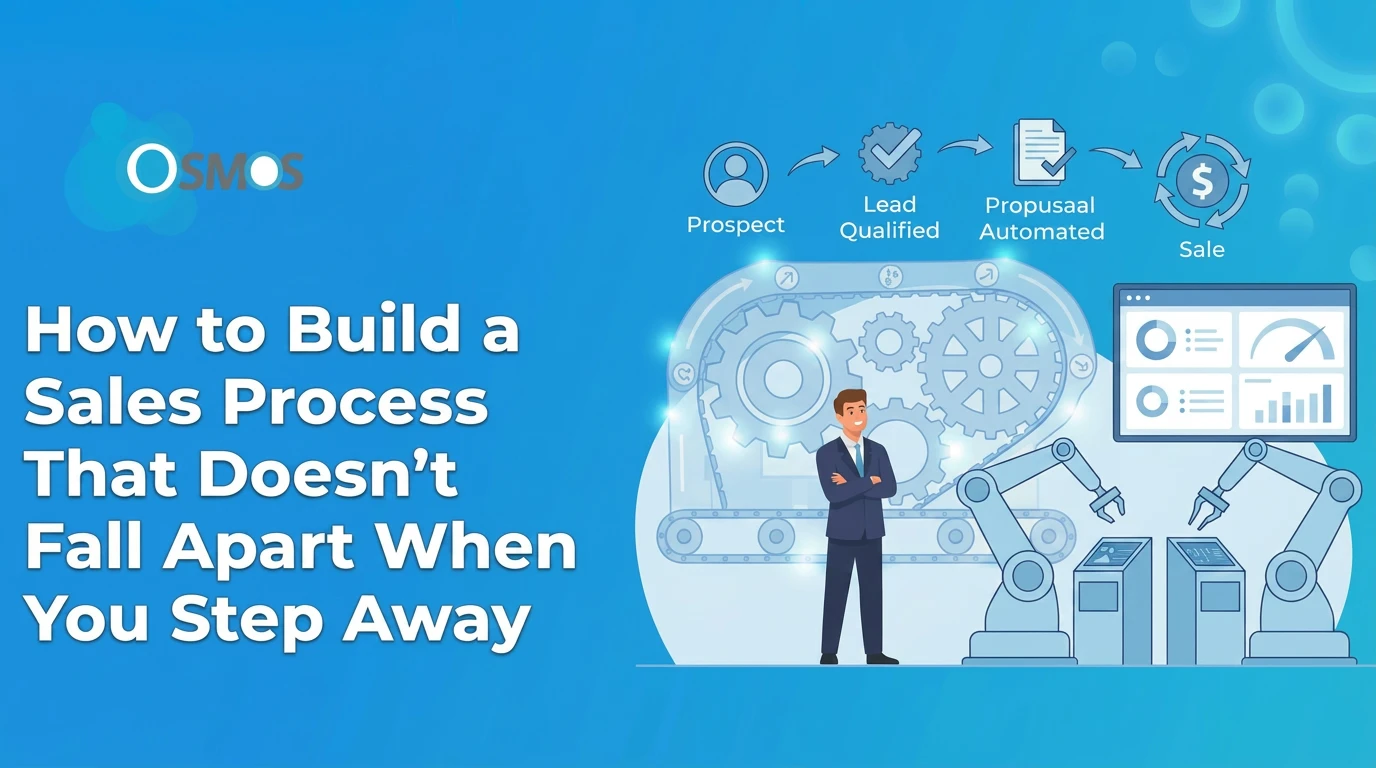
Here's a quick test: take a day off without telling your sales team. Don't check your phone. Don't approve quotes. Don't remind anyone to follow up. Come back the next morning and see what happened.
For most small distributors, the answer is: not much. A few quote requests sat unanswered. A couple of follow-ups that should have gone out didn't. Maybe a rep was waiting on your price approval before sending anything at all.
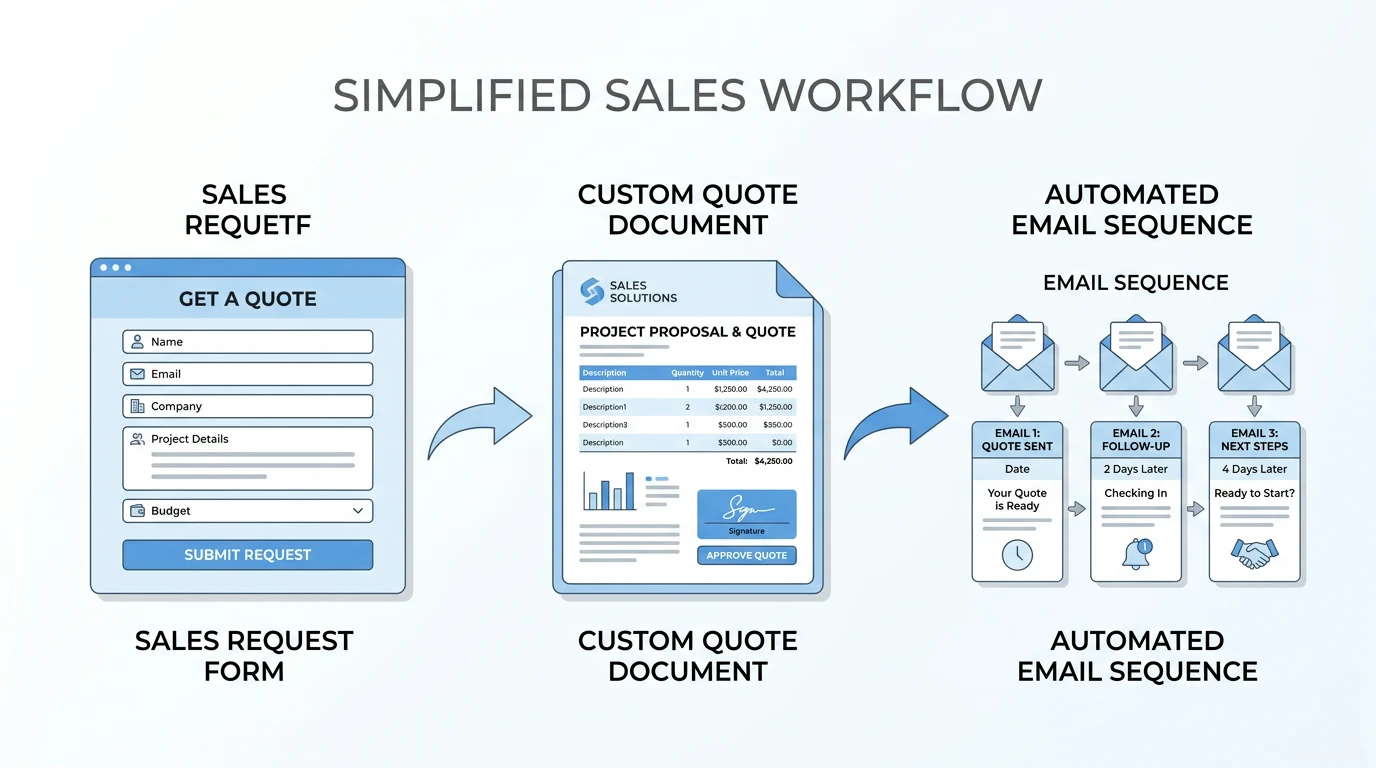
That's not a people problem. It's a systems problem. And the good news is that fixing it doesn't require more headcount or enterprise software. It requires three things: a standard way to capture quote requests, a consistent format for sending quotes, and automatic follow-up that doesn't depend on anyone's memory.
The Real Problem: Your Process Lives in Someone's Head
Most small sales teams don't have a process. They have habits. One rep knows to follow up on day three. Another sends quotes with detailed specs; another sends bare-bones numbers. The owner steps in whenever a deal gets complicated — which is most of the time.
This works fine until it doesn't. A busy week hits. A rep goes on vacation. You're traveling. Suddenly, quotes that should have gone out in two hours take two days, and nobody followed up on the batch you sent last Tuesday.
Research from SuperOffice puts a number on this: companies with a formal, structured sales process see up to 28% higher revenue than those without one. That's not because the process is magic — it's because consistency compounds. When every quote goes out the same way and every prospect gets followed up on schedule, fewer deals fall through the cracks.
The fix isn't complicated. But it does require you to stop treating your best rep's instincts as the process and start writing things down.
Step One: Standardize How You Capture Requests
If customers are currently emailing quote requests to your reps' personal inboxes, you have a visibility problem. When that rep is out, the request is invisible. When they're overwhelmed, it gets buried. And you have no way of knowing what came in or when.
The solution is a single, consistent intake point. That might be a shared inbox, a form on your website, or an embeddable widget that lets customers self-select the products or services they want quoted. The format matters less than the consistency: every request comes in the same way, lands in the same place, and triggers the same next step.
This is one of the problems Osmos was built to solve. The e-quote widget sits on your website — or your Facebook page — and captures structured quote requests automatically. Instead of a rep playing phone tag to figure out what the customer actually needs, the request arrives with the relevant details already filled in. That's one less thing that depends on someone remembering to ask.
The broader principle applies even if you're not using Osmos yet: pick one intake channel and stick to it. A shared inbox beats five personal ones. A simple form beats a free-for-all.
Step Two: Make the Quote Itself Consistent
Once a request comes in, the next failure point is the quote itself. If every rep builds quotes differently — different formats, different levels of detail, different response times — you can't predict what a customer is going to receive or when.
The fastest way to fix this is to look at what your best rep already does and copy it. What information do they always include? How do they present pricing? What does their standard quote look like? That's your template. Write it down, build it into your quoting tool, and make it the default for everyone.
This is also where common quoting mistakes tend to cluster: missing line items, inconsistent pricing, quotes that go out without images or specs. A standard template eliminates most of these by default.
It's also worth doing this: look at your last ten closed deals and work backwards. What did those quotes have in common? What did the customer ask about before they said yes? That's your signal for what to include every time. IMPACT's guide on building a sales process calls this the "map your last 10 wins" exercise, and it's one of the more practical things you can do to build a process grounded in what actually works.
Step Three: Take Yourself Out of the Approval Loop
This one is harder, but it matters more than the other two.
In a lot of small distributorships, the owner is the bottleneck. Every quote over a certain size needs sign-off. Every discount needs approval. Every edge case gets escalated. It feels like control. In practice, it's the thing that makes your process collapse the moment you're unavailable.
The fix is guardrails, not availability. Define what your reps can handle on their own: a standard discount range, a maximum quote value, a list of products they can price without checking in. Anything outside those guardrails gets escalated — but inside them, reps move independently.
That's the difference between a process and a habit. A habit requires the same person to show up every time. A process has rules that anyone can follow.
If you want to understand how much of your team's time is going to approval loops and manual admin, try a simple time audit: track activities in 30-minute blocks for a week and sort them into things that directly move deals forward, things that support the process, and things that are pure friction. Most teams are surprised by how much ends up in that third category.
Step Four: Automate the Follow-Up
This is where most deals actually die. Not because the quote was wrong or the price was off — because nobody followed up.
Most reps give up after one or two touches. Most deals require more than that. The gap between those two facts is where revenue quietly disappears.
Manual follow-up is unreliable by design. It depends on someone remembering, having bandwidth, and knowing when to reach out. When your rep is juggling 30 active quotes at once, some of those follow-ups simply aren't going to happen.
The answer is to take memory out of the equation entirely. Set up a sequence: quote goes out, a follow-up email goes out automatically on day two, another on day five, maybe a third a week later. Nobody has to remember. Nobody has to check a spreadsheet. The sequence runs on its own.
That's exactly what automated quote follow-up is designed to do. You define the rules once, and after that, every quote gets the same consistent follow-up — whether your rep is slammed or out of the office.
High-performing reps are obsessive about next steps. They always end a conversation with a specific scheduled action. Automation does the same thing at scale: it ensures every quote has a defined next step, and that step actually happens.
What Visibility Actually Looks Like
Once intake, quoting, and follow-up are running consistently, you need one more thing: a way to see what's happening without having to ask your reps.
Most pipeline stages are built around what the rep did, not what the buyer did. "Quote sent" and "Waiting on customer" tell you about your team's activity — they don't tell you whether the deal is moving. A better approach is to define stages around buyer milestones: has the customer confirmed they're evaluating options? Have they committed to a timeline? Have they asked about payment terms?
That kind of visibility matters most when you're not in the room. If you can look at a pipeline and immediately see which deals have had buyer engagement in the past week versus which ones have gone quiet, you know where to focus — without asking your reps for a status update on every open quote.
If you're still tracking this in a spreadsheet, it's worth a few minutes to understand what a quotation system can actually do for your visibility.
The Actual Goal
The goal here isn't to remove yourself from sales entirely. You're still going to close deals, manage relationships, and make judgment calls. That's your job.
The goal is to make sure the mechanical parts of the process — capturing requests, sending quotes, following up, tracking status — don't depend on you being present. Those parts should run consistently on their own, whether you're in the office or not.
If they don't, you don't have a sales process. You have a collection of habits that work when the right people are in the room. That's a fragile foundation for a business.
The good news: you probably already have most of what you need. Your best rep already knows what a good quote looks like. Your last ten closed deals already tell you what buyers need to feel confident. You just haven't written any of it down yet.
Start there. Document what works. Build it into your tools. Automate the steps that don't need a human. Then actually step away and see what happens.
That's the test. And if your process holds up, you'll know you built something real.